If your organic traffic looks different than it did a year ago, you are not imagining things. Google has been placing AI-generated summaries at the top of more and more search results, and for a lot of med spa owners, that has translated into flat or declining clicks even on pages that still rank well.
Here's what gets lost in most of the panic: this is a change in how people move from search to your website, not the end of search marketing. AI Overviews and SEO are not competing forces. Practices that understand what is actually shifting can adapt their strategy instead of abandoning it.
Google AI Overviews Are Changing What a Search Result Looks Like
An AI Overview is a summary Google generates at the top of the search results, pulling information from multiple sources to answer a query directly. Instead of seeing a list of traditional organic results first, a searcher may see a synthesized answer with links to some of the sources Google used.
For someone searching “how long does Botox last,” that summary may be enough. They get a quick answer without ever clicking through to a website.
That is a meaningful change to the search experience. It doesn't mean SEO is dead. Google still relies on web content to provide information for AI Overviews, and organic search remains an important traffic source. What has changed is the path between appearing in search and earning the click.
Why AI Overviews Can Change Your Organic Traffic
Much of the confusion about Google search changes comes from treating five different things as one metric. They are not.
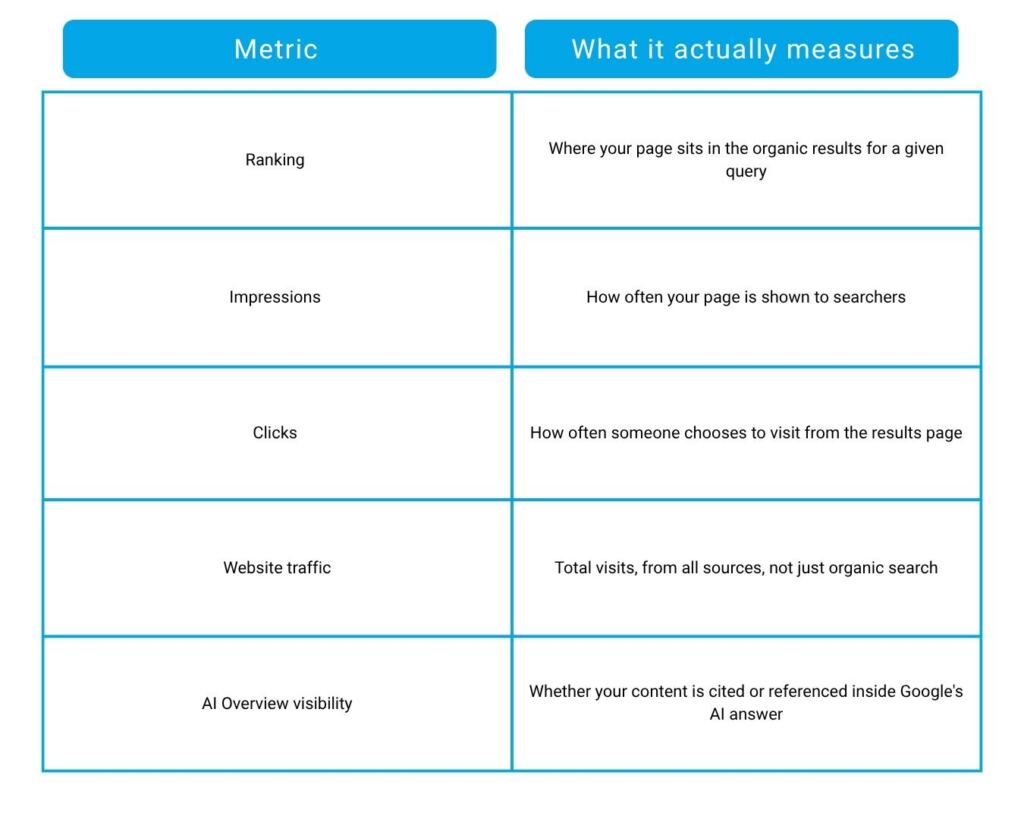
Your page can hold position two, collect the same impressions it always has, and still get fewer clicks because the searcher found what they needed before scrolling. That is the mechanic behind most of what practices describe when they say AI Overviews are hurting their traffic. It shows up most on informational queries:
- Treatment comparisons, like microneedling versus RF microneedling
- Recovery questions, like how long redness lasts after a laser treatment
- Cost questions, like average pricing for a syringe of filler
- Basic “what is” searches
- Treatment suitability questions
Be precise here, though. Not every AI Overview reduces clicks, and not every site sees declining organic traffic. The effect varies by query and by how much value your page offers beyond the summary. Look at your own data before assuming the trend applies to your practice.
Don't Abandon SEO Just Because Google Uses AI
Google's AI answers are built from indexed web content. If your site isn't crawlable, authoritative, or ranking, it isn't a candidate for citation either. Weak SEO does not become an advantage in AI search. It compounds.
If you have been reading about GEO and SEO and wondering whether you need to pick one, you do not. Generative engine optimization is largely an extension of good SEO practice, and the same is true for getting your med spa mentioned in ChatGPT.
Everything that made a med spa website competitive before still applies:
- A technically sound site that loads quickly and is easy to crawl
- Strong service pages for each treatment you offer
- Location pages if you operate multiple locations
- Genuinely useful educational content
- Internal linking that connects related topics and pages
- Local SEO and a well-maintained Google Business Profile
- Accurate, authoritative medical information
- Clear information about your practice, providers, and services
It also includes the fundamentals that determine whether your site can compete in traditional search in the first place. If a competitor is consistently outranking you, AI Overviews are not necessarily the problem. Understanding why your competitor outranks you is still where the diagnosis starts.
The strategy is not SEO versus AI search. It is adapting med spa SEO to an environment where patients may interact with an AI-generated answer before deciding whose website to visit.
How Med Spas Can Adapt Their SEO Strategy for AI Overviews
Build Content That Goes Beyond the Basic Answer
If your article's entire value is one sentence of definition, Google can now deliver that sentence itself. That content will struggle.
What holds up is content a summary cannot replace:
- Context about why a treatment works the way it does
- Honest comparisons between similar treatments
- Practical considerations, like what to expect at week two versus week six
- Provider perspective drawn from actual patient experience
- Original insight, including what you see in your own practice
- Detailed explanations of edge cases and exceptions
- Answers to the follow-up questions a summary leaves open
Think about the searcher who reads the AI Overview and still has questions. That person is your audience.
Strengthen Your Service Pages
The AI conversation pulls attention toward blog content, and that is a mistake. Service pages are where commercial intent lands and where bookings actually happen.
A strong service page communicates:
- What the treatment is and what your practice specifically offers
- Who the treatment may be appropriate for
- What a patient can expect during and after
- Considerations, downtime, and realistic timelines
- Which of your locations offer it
- A clear, obvious next step to book a consultation
If your service pages read like thin brochures, fix those before you rewrite a single blog post.
Create Content Around the Patient Journey
Instead of publishing isolated articles chasing individual keywords, build clusters around what patients ask before, during, and after treatment.
For Botox, that might look like:
- Before: Am I a candidate for Botox?
- During: What happens during a Botox appointment?
- After: How long does Botox take to work?
Then link each of those to your Botox service page. This does two things: it covers the real question set a patient works through, and it gives Google a clear topical structure to understand.
Demonstrate Real Expertise
Content written by or reviewed by your actual injectors, nurses, and physicians reads differently than content assembled to hit a word count. Name your providers. Include their credentials. Reference what you actually see in treatment.
To be clear, no one can promise that expert content guarantees inclusion in an AI Overview. No published formula exists, and anyone selling you one is guessing. But Google has consistently rewarded credentialed medical content in health categories, and it earns patient trust once someone lands on your page.
These strategies overlap heavily with traditional SEO, but practices looking to build visibility across AI-powered search can take that work further through a dedicated GEO strategy.
Optimize for Visibility, Not Just Clicks
The reporting habit most practices need to break is treating clicks as the only number that matters. If a patient sees your practice cited in an AI Overview, sees you again in the local pack, then searches your name two days later and books, your analytics credit that booking to branded search. The article that started the process shows zero clicks.
That does not mean the content failed. It means your measurement is too narrow. The goal was never the largest possible traffic number. It is visibility that contributes to patient acquisition.
What Med Spas Should Measure as AI Search Grows
Organic Traffic
Still worth tracking, but interpret it in context. Segment informational pages from service and location pages. A dip concentrated in “what is” articles tells a very different story than a dip on your CoolSculpting page.
Search Impressions
Impressions show whether Google still surfaces your practice even as clicks shift. Stable impressions with softer clicks usually mean the presentation changed, not your standing.
Rankings
Keep monitoring commercial queries, especially treatment-plus-location searches. These are closest to revenue and least affected by AI summarization.
Leads and Consultations
Form fills, calls, and booked consultations are the metrics your practice actually runs on. If these are steady or growing while traffic softens, your SEO program is working.
Branded Search
Growth in searches for your practice name can indicate that visibility is building awareness. Treat it as one signal among several, not as a standalone measure of AI Overview performance.
Focus on the Searches That Actually Drive Patients
Not every search deserves equal investment. This distinction should shape your priorities. Informational queries are the ones most likely to be answered inside an AI Overview. They still matter because they build authority and support the patient journey, but they don't drive bookings.
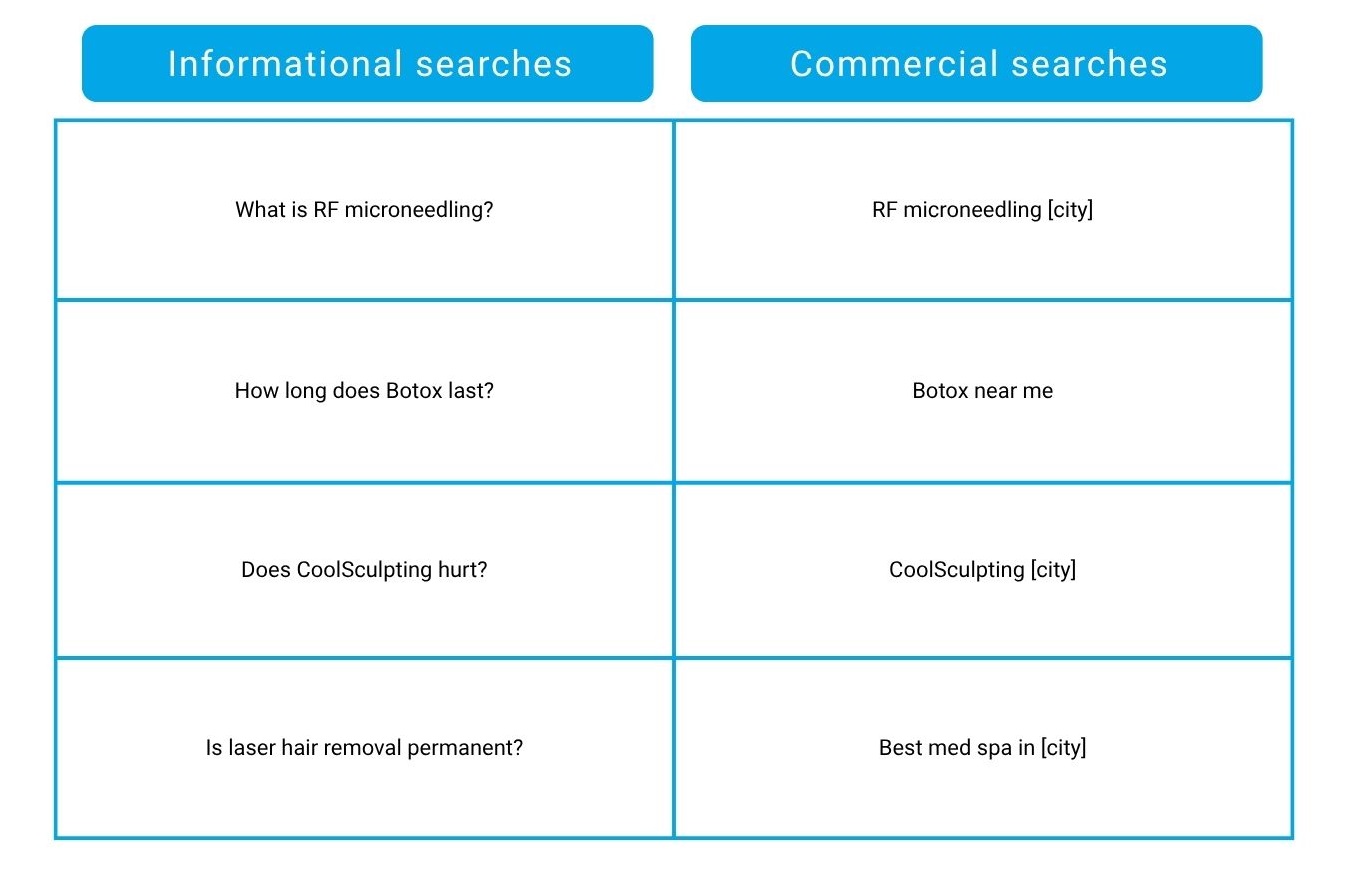
Commercial and local searches are. Someone typing “Botox near me” wants a provider, not a definition, and Google still serves those results with maps, listings, and websites. Keep investing heavily in local SEO for med spas, your Google Business Profile, reviews, and location-specific service pages.
What Not to Do in Response to AI Overviews
Don't Stop Publishing Helpful Content
Pulling back from content production removes you from the pool Google draws on. Publish less filler, not less content.
Don't Stuff Pages With AI-Generated Filler
Volume without substance was already a losing strategy. It is a faster loss now.
Don't Rewrite Every Existing Article Just Because AI Search Exists
Audit first. Prioritize pages with real commercial value or clear quality gaps. Most of your library probably does not need touching.
Don't Ignore Your Service and Location Pages
These are your conversion assets. They deserve just as much attention as your blog, if not more.
Don't Measure SEO Success by Traffic Alone
If clicks are your only KPI, you will make bad decisions about content that is quietly generating patients.
The Future of Med Spa SEO Isn't SEO vs. AI
Google's search experience is changing, and it will keep changing. What has not changed is the underlying requirement: be visible, credible, and easy to choose when someone in your area is looking for the treatments you provide.
The practices best positioned for this shift are not the ones chasing every new AI search optimization tactic. They are the ones with:
- A technically healthy website
- Service pages that clearly explain what they offer
- Strong local SEO across every location
- Authoritative, provider-backed content
- Visible, credentialed expertise
- Conversion paths that make booking easy
- Consistent, honest measurement
AI search is another layer of the search ecosystem, not a replacement for everything underneath it. Build a strong foundation, and you can compete in both.
Don't Let Search Changes Leave Your Med Spa Behind
If your organic traffic has shifted, or you are wondering how your SEO strategy should evolve as Google incorporates more AI into search, Medstar Media can help you assess where your practice stands and identify opportunities to strengthen visibility and patient acquisition.
Schedule your free strategy consultation with Medstar Media.
Frequently Asked Questions
Will AI Overviews hurt my med spa's website traffic?
They may reduce clicks on informational content, particularly basic “what is” and “how long does it last” articles. Commercial and local searches such as treatment plus city queries have been far less affected. Review your own search data by page type before drawing conclusions about your practice.
Should med spas still invest in SEO?
Yes. Google's AI answers are built from indexed, ranking web content, so technically sound, authoritative sites remain candidates for citation. Sites not visible in traditional search aren't visible in AI search either.
How do I get cited in Google AI Overviews?
No published formula or guaranteed method exists. What appears to help is content that is accurate, well-structured, credentialed, and offers depth beyond a one-sentence answer. Treat citation as a possible outcome of strong SEO, not a target you can engineer directly.
How should I measure SEO if clicks are declining?
Look at impressions, rankings on commercial queries, branded search volume, form fills, calls, and booked consultations together. A practice can see softer organic clicks while consultations hold steady or grow, which usually means visibility is working even though attribution has gotten harder.
Do I need a separate strategy for AI search?
Not a separate one. Most of what helps with AI visibility overlaps heavily with good SEO practice: crawlable pages, clear structure, genuine expertise, and content that answers real patient questions in depth.