
There is no magic number, and that is genuinely good news.
A med spa website needs enough pages to clearly represent its treatments, locations, providers, and the questions patients ask before booking. That might be fifteen pages for a focused single-location practice or eighty for a multi-location group with a wide treatment menu. Both can be excellent websites.
What matters more than the count is whether each page has a job. A well-organized twenty-page site will usually outperform a hundred-page site built by multiplying keyword variations, because patients and search engines can both understand it.
If you are planning a build or a redesign, this guide covers which pages actually earn their place, how to decide whether a treatment deserves its own page, and how to grow the site over time without creating clutter.
What Determines How Many Pages You Need
Your page count is an output of your practice, not a target to hit. The main inputs include:
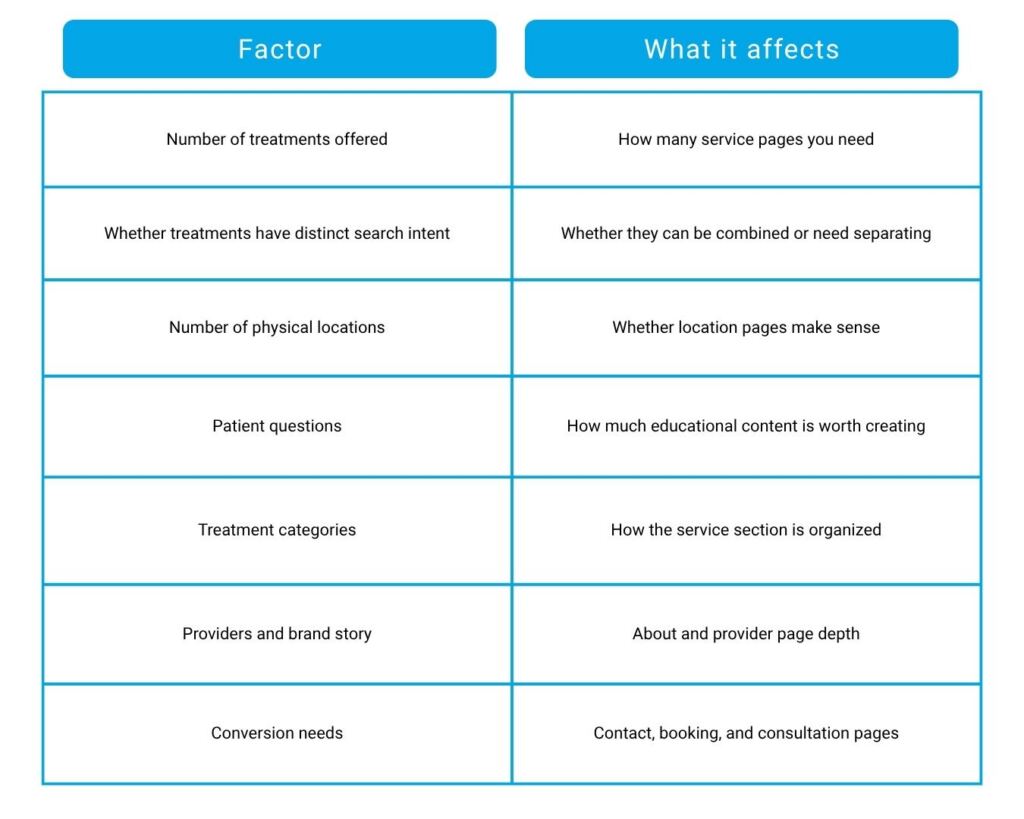
Two practices can offer the same treatments and have different page counts, and both can be right. The useful question isn't “How many pages should we have?” It's “Does every page we have serve a purpose?”
What Pages Does Every Med Spa Website Need?
Most practices will want these foundational pages regardless of size.
Homepage
Your homepage answers the basics quickly: who you are, where you are, what you offer, who provides the treatments, and what to do next.
Resist the temptation to make the homepage rank for every treatment individually. That job belongs to your service pages. The homepage works best as an orientation point that routes people to what they came looking for.
About Page
This is where patients get comfortable with you. Your story, your approach, your providers, and their credentials all belong here.
In aesthetics, this page does more work than people expect. Patients are making decisions about their faces and bodies, and knowing who will be holding the syringe matters to them. If you have several providers, individual provider pages are often worth adding.
Contact Page
Patients need an obvious way to reach you. Address, phone, hours, a form, and a map, all easy to find from anywhere on the site.
If you have multiple locations, this page can route people to the right one instead of trying to include every detail.
Service and Treatment Pages
These pages bring in patients actively looking for what you offer, making them the most commercially valuable part of the site.
Treatments that commonly earn their own page include:
- Botox and neurotoxins
- Dermal fillers
- Laser treatments
- Microneedling
- Body contouring
- Weight loss programs
- Hormone therapy, where offered
That list is illustrative, not prescriptive. What matters is whether patients search for the treatment by name and whether you actively want to attract it.
How Many Service Pages Should a Med Spa Have?
As many as your treatment menu genuinely supports, which is a less satisfying answer than a number but a more useful one.
A treatment generally deserves its own page when it meets most of these conditions:
- It is a meaningful service in your practice, not an add-on
- Patients search for it by name
- There is enough to say to fill a substantial page
- The benefits, candidates, considerations, and expectations differ from your other treatments
- You actively want to attract patients for it
When treatments are closely related, and the information overlaps heavily, grouping them into one strong category page often works better than splitting them into several thin ones. A single well-built laser resurfacing page that covers your specific devices and their differences will usually serve patients better than three near-identical pages.
There is no correct number here. A practice offering eight treatments doesn't need twenty service pages, and a practice offering thirty doesn't need to squeeze them onto five.
Does Every Treatment Need Its Own Page?
Not necessarily, and this is worth thinking through carefully before a build.
A dedicated page makes sense when the treatment has enough standalone substance to justify it and serves a distinct patient need. It makes less sense when you would essentially be publishing the same page with a different treatment name at the top.
That situation causes a specific problem. When several pages target very similar queries, search engines have difficulty deciding which one to show, and your pages can end up competing with each other rather than with your competitors. The pages also tend to be thin because there wasn't enough unique information to fill them in the first place.
The goal is a page for every treatment that deserves one, not a page for every keyword variation. If you are working through this as part of a broader audit, our med spa SEO checklist covers how service pages fit alongside the rest of the site.
Do Med Spas Need Location Pages?
If you have more than one physical location, yes. Each office deserves a page that represents it properly.
A useful location page includes:
- The actual address, phone number, and hours for that office
- Which services are available there
- Which providers work there
- Directions, parking notes, and local context
- Photos of that specific space
- A clear way to book at that location
What tends not to work is creating pages for nearby cities where you do not actually have an office. Those pages are usually thin; they rarely reflect anything real about your practice, and patients who arrive there don't find what they came for.
Location pages work when they correspond to real places. Your Google Business Profile does a lot of the local visibility work alongside them, which we cover in why your Google Business Profile isn't bringing you patients.
How Many Blog Posts Does a Med Spa Need?
There is no ideal number here either, and blog content works differently from your core pages.
Service and location pages describe what you offer. Blog content answers the questions patients have while they are deciding. Useful topics tend to cluster around:
- What a treatment is and how it works
- Whether someone is a good candidate
- How to prepare
- What recovery looks like
- When results appear and how long they last
- Comparisons between similar treatments
- Side effects and considerations
A dozen genuinely useful articles connected to your service pages will do more than a hundred short posts written to fill a calendar. If you are starting from zero, that is a completely reasonable place to begin. Pick the questions your front desk answers most often and start there.
More Pages Do Not Automatically Mean Better SEO
Adding pages helps when they cover topics your patients care about and your site doesn't yet address. Page count alone is not a strategy.
When a site grows without a plan, a few issues tend to appear:
- Thin content. Pages with too little substance to be useful to anyone.
- Repetition. Several pages saying nearly the same thing.
- Keyword cannibalization. Your own pages competing for the same searches.
- Confusing architecture. Patients unsure where to go, and important pages buried.
- Weak internal linking. Pages that nothing else points to.
- Maintenance load. Every page needs updating when treatments, pricing, or providers change.
None of this means a large site is a bad site. Plenty of excellent med spa websites run well past a hundred pages. The difference is that each page was created for a reason.
How to Decide Whether Your Med Spa Needs a New Page
Before adding a page, this short checklist tends to settle it:
- Is this an important service or topic for our practice?
- Are patients actually searching for this?
- Does it have a distinct search intent, separate from our other pages?
- Can we write enough genuinely useful information to fill it?
- Is there already a page on our site doing this job?
- Does it help patients make a decision?
- Does it have a clear home in the site structure?
If most answers are yes, build it. If the honest answer to the fourth or fifth question is no, the content usually belongs inside an existing page instead.
A Practical Med Spa Website Structure
Here is what a well-organized site might look like. This is an example, not a required page count.
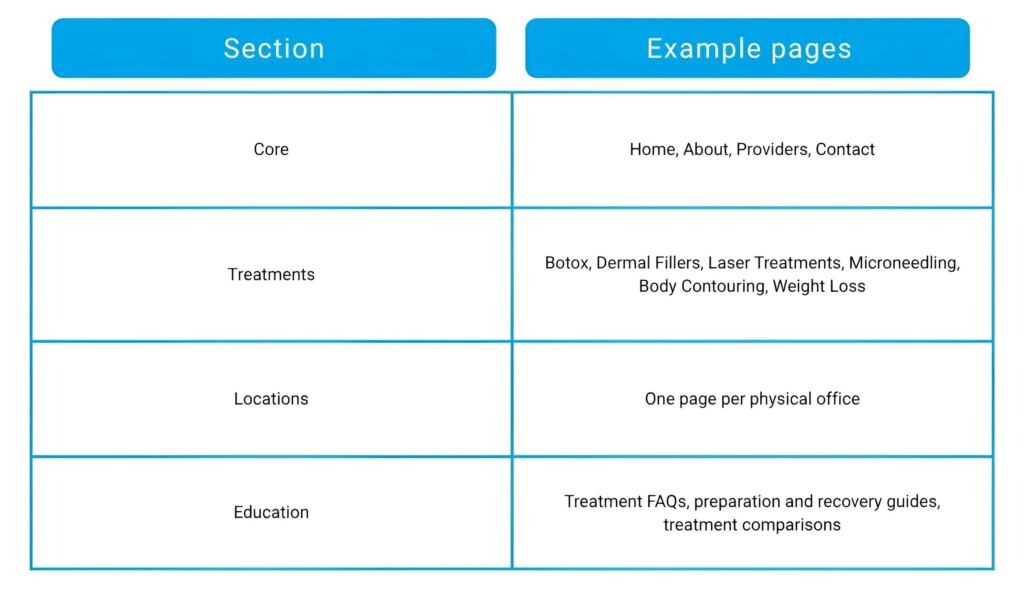
That example lands somewhere in the teens before blog content, which is a perfectly healthy size for a single-location practice. A larger group with more treatments and three offices would naturally run bigger. Neither is more correct.
The structural point matters more than the list: treatments sit together, locations sit together, and educational content links to the service pages it relates to.
When Should You Add More Pages?
Adding pages makes sense when something real changes:
- You add a treatment you want to attract patients for
- A treatment turns out to have its own distinct search demand
- You open a new location
- Patients keep asking a question that deserves a proper resource
- An existing page is trying to serve two different intents and would work better split
- There is a genuine gap in the patient journey your site does not cover
Notice what is not on that list: hitting a number, matching a competitor's page count, or publishing on a schedule for its own sake.
What Matters More Than Page Count
If you are deciding where to put effort, these move the needle further than adding URLs:
- Information that actually answers what patients want to know
- A clear service architecture patients can navigate
- Strong, substantial treatment pages
- Local relevance for the areas you serve
- Internal links that connect related pages
- Visible provider credentials and medical accuracy
- Technical health, so pages can be crawled and load quickly
- Easy navigation
- Obvious conversion paths on every page
The best med spa website is not the biggest one. It is the one that gives patients and search engines a clear picture of who you are, what you offer, and where to go next. For treatment-specific strategy, our guides on ranking for Botox and fillers and plastic surgery SEO go deeper into individual categories.
If you are planning a build or looking at a site that has grown without much structure, Medstar Media can help you map out what your practice actually needs and where the gaps are.
Schedule a strategy consultation with Medstar Media.
Frequently Asked Questions
How many pages should a med spa website have?
There is no universal number. It depends on how many treatments you offer, how many locations you have, and how much patient education your services call for. A focused single-location practice might do well with fifteen to twenty pages, while a multi-location group could reasonably need several times that.
What pages should a med spa website have?
At minimum: a homepage, an about or providers page, a contact page, and a dedicated page for each significant treatment. Add location pages if you have more than one office, and educational content that answers common patient questions.
Does every med spa treatment need its own page?
No. A treatment earns a page when patients search for it specifically, and you have enough substantial information to fill the page. Closely related treatments with heavy information overlap often work better grouped into one strong category page.
Do location pages help med spa SEO?
They help when they represent real offices with genuine location-specific information. Pages created for nearby cities where you have no physical presence tend to be thin and rarely perform well.
How many blog posts should a med spa publish?
There is no target number. A smaller set of thorough articles answering real patient questions, each linked to a relevant service page, does more than a large volume of short posts.
Does having more pages improve SEO?
Not by itself. Pages help when they cover topics your site doesn't yet address and patients are actively searching for. Adding pages without that purpose can create thin content and internal competition.
How often should a med spa add new website pages?
Add pages when something changes, not on a schedule. A new treatment, a new location, a recurring patient question, or a page trying to serve two intents at once are all good reasons. No change, no new page needed.