
Skip to content

The Real Cost Per Lead for Botox, Fillers, Weight Loss & Plastic Surgery

If you have ever looked at a marketing report, seen a cost per lead figure, and wondered whether it was good or bad, you are asking exactly the right question. It is also one of the harder questions in aesthetic marketing to answer well, because cost per lead on its own doesn't tell you much.

The good news is that there is a clear way to think about it. This guide walks through what drives cost per lead for a med spa, what the available data does and doesn't tell us, and how to set a target that fits your practice, your market, and your treatments.

No prior marketing background needed. If some of this is new to you, that is completely normal.

What Does a Med Spa Lead Actually Cost?

Cost per lead, or CPL, is one of the most talked-about numbers in marketing, and one of the easiest to misread.

Part of the reason is that “a lead” can mean very different things. Someone who searches “Botox near me,” lands on your site, and calls to ask about pricing is in a different place than someone who sees a promotional offer in their social feed and taps a form to claim a discount. Both are leads. Both will show up as one line in your reporting. They rarely behave the same way afterward.

So when someone quotes you a single industry-wide CPL for med spas, the number usually mixes different treatments, markets, channels, and definitions of what counts as a lead.

That does not make CPL useless. It just means the number needs context to be meaningful.

Why Cost Per Lead Varies So Much

Treatment and Procedure

A neurotoxin appointment and a surgical procedure have very different economics. Higher-value procedures can generally support a higher acquisition cost, while lower-ticket treatments may rely more on repeat visits and retention.

Neither model is inherently better, but you shouldn't compare their CPLs directly.

Location and Competition

Market size, local competition, household income, and the number of practices competing for the same searches can all affect what you pay for a lead.

A practice in a competitive metro market may have higher acquisition costs than one serving a smaller market with fewer competitors. That does not necessarily reflect marketing performance. It can simply reflect the level of competition.

Lead Source

Different channels reach patients at different stages of the decision-making process, which affects both CPL and lead quality.
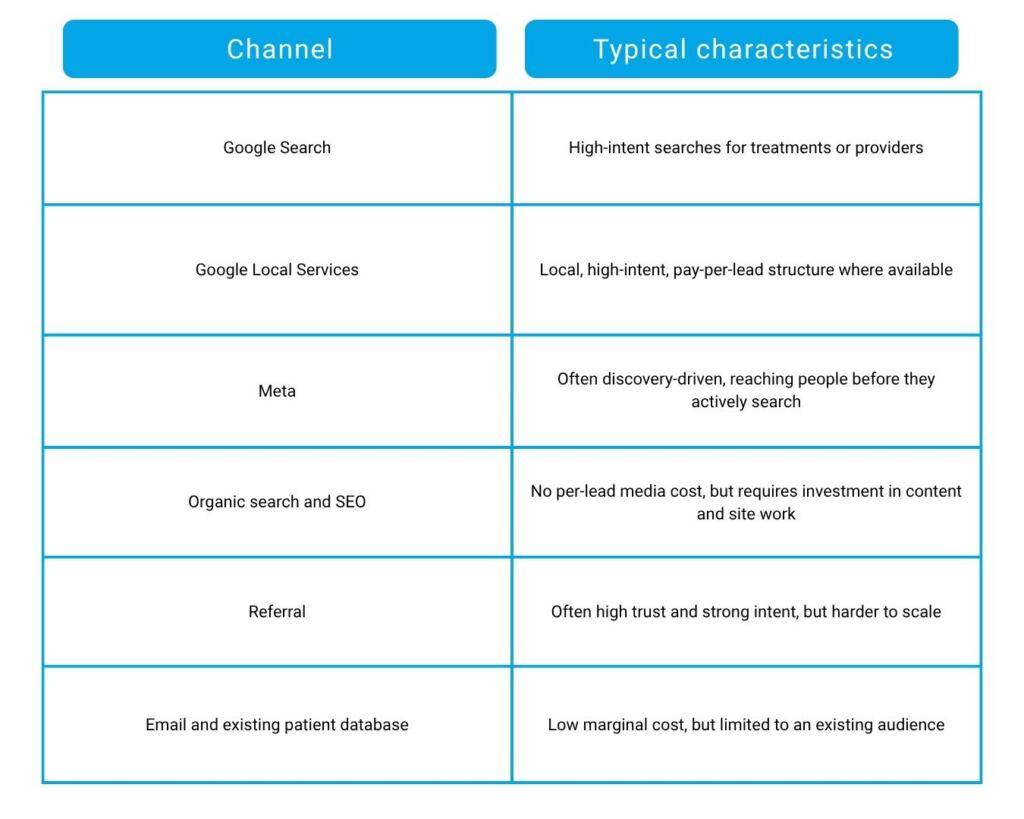
Lead Source
A lower CPL does not automatically mean a better-performing channel. The more useful comparison is what each channel costs to acquire a patient, not simply what it costs to generate a form submission.

For more on paid channel strategy, see our guide to using paid ads in your local aesthetic market.

Offer and Landing Page

Your landing page affects how many visitors become leads, which directly affects CPL.

A clear offer, useful information, visible provider credentials, a simple form, and an easy way to get in touch can all support conversion. When more of your existing traffic converts, your cost per lead decreases without increasing ad spend.

What Is a Good Cost Per Lead for a Med Spa?

“Good” cannot be determined from CPL by itself. A $40 lead that never books is more expensive than a $150 lead that becomes a patient. To know whether your CPL is working, you need to see it alongside:

  • Lead qualification rate, meaning how many inquiries are real candidates
  • Consultation booking rate
  • Consultation show rate
  • Treatment conversion rate
  • Average revenue per new patient
  • Gross margin, where you can calculate it
  • Lifetime value for patients who repeat treatments, or for memberships
  • The cost of the marketing and staff time involved

If you do not have all of those numbers today, that is a very common starting point, and it is fixable. Even rough estimates will make your CPL far more interpretable than it is now.

How to Calculate Your Med Spa's Cost Per Lead

Cost Per Lead = Total Marketing Spend ÷ Number of Leads Generated

The judgment call is what you include in “marketing spend.” Depending on what you want to understand, that might include:

  • Ad spend
  • Agency or campaign management fees
  • Creative production costs
  • Landing page or website costs
  • Software and tracking tools

There is no universally correct answer. A media-only CPL tells you how efficiently the ads are performing. A fully loaded CPL tells you what a lead really costs the business. Both are useful.

What matters is consistency. If you compare a media-only CPL from one campaign to a fully loaded CPL from another, the comparison will mislead you every time. Pick a definition, write it down, and apply it the same way across everything you measure.

CPL Is Only the Beginning

A lead has to move through several steps before it becomes revenue:

Lead → Qualified Lead → Booked Consultation → Attended Consultation → Treatment → Revenue

Each step can have its own drop-off rate. Looking only at CPL can therefore give you an incomplete picture of campaign performance.

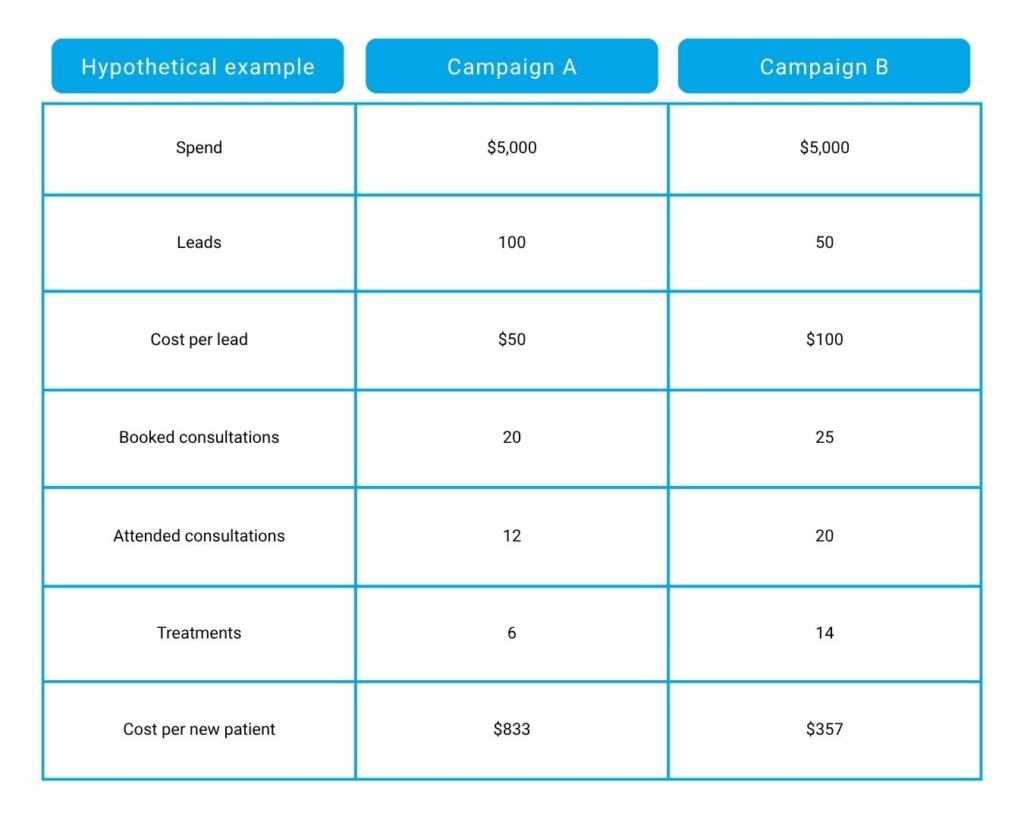
Consider this hypothetical example. The numbers are for illustration only and are not industry benchmarks:
CPL Is Only the Beginning
Campaign A generates twice as many leads at half the CPL, but Campaign B produces more than twice as many new patients from the same spend. Looking only at initial lead cost would make Campaign A look more efficient, even though the opposite is true further down the funnel.

What happens after a lead arrives can significantly affect these results. Follow-up speed, phone handling, consultation booking, and the consultation process can all influence how many leads ultimately become patients.

For more on that part of the funnel, see how to increase consultation conversion rates and the 5-minute rule that doubles consultation bookings.

How Treatment Type Changes the Economics

Because reliable treatment-level CPL benchmarks are hard to establish, it is more useful to understand how economics differ across treatment categories.

Botox and Neurotoxins

Neurotoxin treatments generally have a lower average ticket than surgery, so a new patient's value may depend heavily on repeat visits.

Patients who return regularly for maintenance can generate value across multiple appointments, not just from a single treatment. Memberships and treatment plans can further affect that equation.

Searches for Botox are often local and treatment-specific, which can make them competitive while also reaching people who are relatively close to making a decision.

Dermal Fillers

Filler treatments can have a higher average ticket than neurotoxins, but patients may also take longer to decide.

A consultation may be an important part of the process, particularly for facial balancing or more comprehensive treatment plans. That makes consultation booking and show rates important when evaluating the true cost of acquiring a patient.

Filler patients may also return for additional treatments, increasing their value beyond the initial appointment.

Weight Loss

Weight loss programs are often structured around recurring care, so revenue may be generated over several months rather than from a single visit.

That makes patient value and retention important when determining how much acquisition cost a program can support. Lead qualification also matters because not everyone who inquires will be a clinical fit.

Program expenses, including medication costs where applicable, should also be included when evaluating the economics of acquiring and retaining a patient.

Plastic Surgery

Plastic surgery can involve higher potential patient value and a longer decision-making process. Patients may research for months, consult with multiple practices, and carefully consider cost, recovery, and outcomes.

As a result, lead quality, consultation booking, show rates, and procedure conversion all become important parts of the acquisition equation.

Rather than asking whether a surgical lead costs too much compared with an aesthetic lead, compare acquisition cost with the revenue and margin associated with the procedure.

Don't Compare CPL Across Treatments Without Context

Saying “our Botox leads cost $45 and our surgery leads cost $180” does not tell you which campaign is performing better on its own.

A more useful comparison looks at the full funnel:

CPL → booked consultation → attended consultation → procedure → revenue

This shifts the focus from the cost of generating an inquiry to the cost of acquiring an actual patient. Two campaigns with very different CPLs can perform similarly, while two campaigns with the same CPL can produce very different results.

How to Set a Target CPL

Rather than adopting an outside benchmark, you can work backward from your own economics. Here is a framework:

  1. Determine average revenue per new patient. Start with first-visit revenue, then add repeat-treatment value if you have it.
  2. Determine realistic conversion rates. What share of leads qualify, book, show, and treat? Estimates are fine to begin with.
  3. Decide what acquisition cost the practice can support. This depends on your margin and your growth goals.
  4. Work back to a target cost per qualified lead. If you can support $400 to acquire a patient and roughly one in eight qualified leads becomes one, your target is around $50 per qualified lead.
  5. Monitor actual performance against that target rather than against an industry figure.
  6. Adjust as you learn more about how your consultations and conversions really behave.

Two practices offering the same treatments in different markets can land on very different sustainable targets, and both can be right. If you are also thinking about overall budget levels, how much a med spa should spend on marketing covers that side of the question.

The Difference Between a Cheap Lead and a Valuable Lead

Lead quality is where CPL and business results often diverge. An inexpensive lead may turn out to be someone who:

  • Lives outside your service area
  • Wants a treatment you do not offer
  • Is comparing prices across several practices
  • Does not respond to follow-up
  • Books but does not show

None of that means the campaign was badly run. Broad, low-cost reach naturally brings in a wider mix of people. It just means the raw lead count overstates the opportunity.

A more expensive lead often carries stronger intent, arrives further along in the decision, and needs less work to convert. For a deeper look at quality, we have written about why aesthetic leads underperform and how to master phone lead conversions, which is often where quality is won or lost.

What Med Spas Should Actually Measure
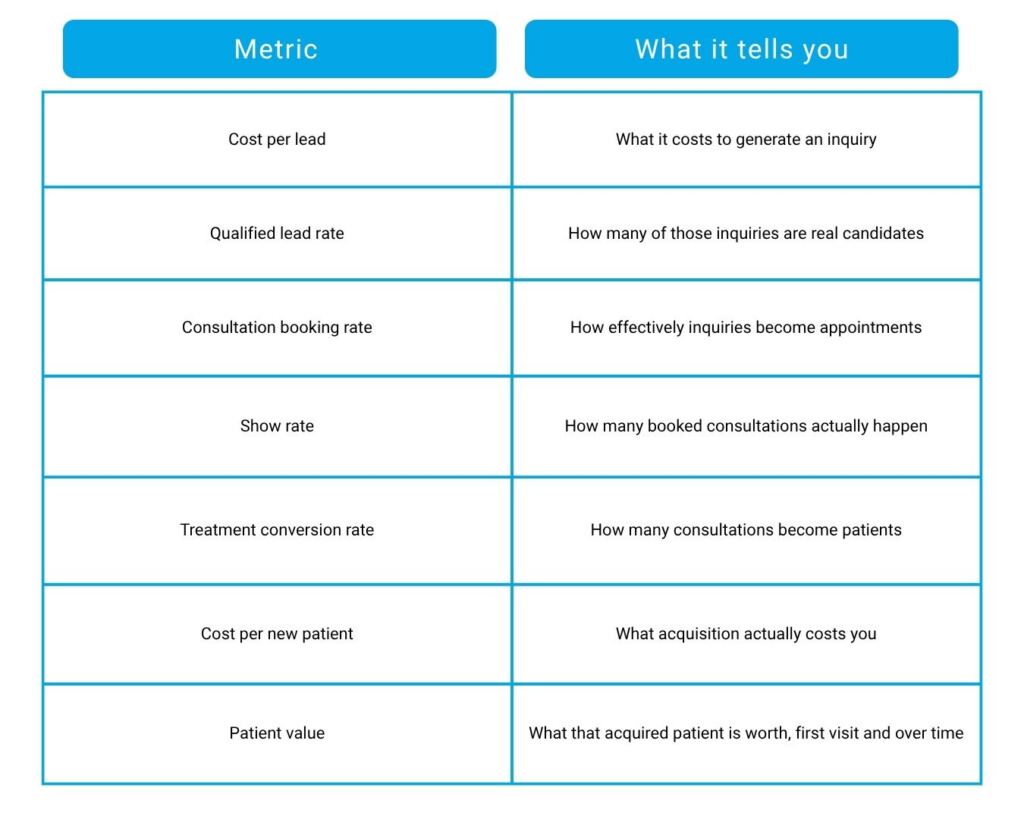
What Med Spas Should Actually Measure
If you can only add one of these to your current reporting, cost per new patient is the one that changes decisions most. It is also worth distinguishing lead volume from lead economics, which we cover in how many leads a med spa should generate each month.

When a Higher CPL Can Actually Be Better

A higher cost per lead isn't a warning sign on its own. If a campaign produces leads that cost more but qualify at a higher rate, show up more reliably, and convert into higher-value treatments, it can be far more profitable. The hypothetical example earlier shows exactly that pattern.

This is why optimizing toward cost per acquired patient tends to serve practices better than optimizing toward the lowest possible lead cost. Chasing cheaper leads can quietly move budget away from the campaigns that are actually producing revenue.

The Real Question Isn't “What's the Average CPL?”

No single cost-per-lead number applies to every med spa. A useful target depends on the treatment, market, lead quality, conversion rates, and patient value.

Instead of focusing on an industry average, ask:

  • What does a qualified lead cost us?
  • What percentage of qualified leads become booked consultations?
  • What percentage of consultations become patients?
  • What does each new patient generate on the first visit and over time?
  • Is that acquisition cost sustainable for this treatment, in this market, and at our margins?

Working through these numbers gives you something more useful than a generic industry benchmark: a target based on your own practice and economics.

If you want help evaluating your acquisition funnel, Medstar Media can identify where leads come from, where they drop off, and what your practice can sustainably spend to acquire a patient. Our Click-Consult-Close Blueprint covers the broader patient acquisition funnel.


Schedule a strategy consultation with Medstar Media.

Picture of About the Author
About the Author

I’m Chris Zelig, Founder & CEO of Medstar Media. I’ve spent over 15 years in the aesthetics and cash-pay medical space, building my career on a lesson my dad taught me early on—keep things simple, fast, and easy. That mindset has become the cornerstone of my marketing approach. I focus on helping small, privately owned providers outperform larger competitors. My first aesthetics client, SKINNEY Medspa, grew from a family-run business into New York City’s #1 medical spa and the world’s leading provider of CoolSculpting and Emsculpt. Since then, I’ve gone on to represent top cosmetic accounts nationwide and create viral campaigns for causes such as early cancer detection.

STEP 1 OF 2 50%

SCHEDULE YOUR FREE MARKETING STRATEGY SESSION BELOW!

We will share with you the strategies the top 1% of providers use to acquire more patients. I will also give you a custom marketing strategy and audit your current website.


Vania

Behind the Screens

I make sure people call their new medspa friends back.
Consistent and creative follow-up with leads
My background in trauma-focused therapy.
A value-based monthly membership program with fun activations keeps your client base engaged with new services and following the recommended treatment protocols.
Christine A.

Behind the Screens

I make internet pictures that try to win people’s attention. Basically, I figure out what will make someone stop scrolling, look twice, and hopefully think, “Hmm, I want that.”
Canva. We’ve spent an unreasonable amount of time together. It’s quick, flexible, and lets me go from a random idea to something people can actually see and react to without making the process unnecessarily complicated.
I’m surprisingly good at making things look effortless, after several very non-effortless attempts. I enjoy taking messy ideas, lots of information, or vague feedback and turning them into something clear and easy to understand.
Don’t guess what works. Test it. Something can look brilliant in theory and completely flop in practice, so I’d rather let the audience tell us what works and keep improving from there.
Rafael A.

Behind the Screens

There are steps needed when handling leads to get the best results possible. It is my job to train practices in these steps and to make sure that, after the training, these steps are taken. I follow up with the teams to address areas of opportunity to constantly improve the lead management process.
My favorite marketing tool is the Medstar App, especially when it’s set up correctly for lead management, automations, follow-up, SMS/email campaigns, and pipeline visibility. It helps connect marketing efforts directly to conversion outcomes.
Besides a magnetic smile, I bring strong lead-management and process-optimization skills. I’m good at reviewing workflows, finding gaps, and helping teams turn more leads into booked appointments.
Don’t let good leads die because of slow follow-up. Marketing gets the lead in the door, but the process behind it is what actually closes the appointment.
Kylie N.

Behind the Screens

I help businesses show up when people search for things on Google. It’s kind of like helping a business put up the right signs so people can find their way to it, only you’re looking online instead of in person.
Google Search Console. I love digging through search data and finding little opportunities hiding in plain sight. It feels a bit like detective work.
Professionally, I’m surprisingly good at turning a big, messy pile of information into something organized and actionable. Personally, I’m a seasoned pro at collecting hobbies.
Don’t create content for algorithms; create it for people. Understand what your audience actually wants to know, then use SEO to help them find it.
Areesha T.

Behind the Screens

I help people work together to build cool things on the internet.
Paint the canvas, spending time with friends & family.
Understanding their vision and helping turn ideas into real results.
Know your audience first — great marketing starts with understanding people.
ChatGPT — my brainstorming partner for ideas and problem-solving.
Nathalia G.

Behind the Screens

I usually step away from the project and do something creative, such as painting, drawing, or listening to music. Giving my mind a break often helps the missing puzzle piece fall into place. When I need inspiration, I like exploring other creative outlets and using them to approach the project from a new perspective.
Spending time with my family and friends! I really value the people around me and enjoy slowing down, being present, and staying offline during those moments.
Always consider the customer and their needs before creating a strategy or plan. One should guide the other. When you understand your audience and maintain strong communication with the client, digital marketing projects tend to run more smoothly and successfully.
Honestly, I’d say Instagram. I love using it to spot trends, see what people are responding to, and understand how brands are connecting with their audiences. A lot of my best ideas come from observing what feels natural on the platform and then finding a way to make it work for the brand.
Positivity! I’m usually the one cheering people on, celebrating the little wins, and bringing good energy to the conversation.
Carie G.

Behind the Screens

I love putting on some music, it always helps me get into the right headspace and set the tone for my design work. Matching the vibe of the music to the brand’s aesthetic is my favorite way to find fresh creative motivation.
When I’m off the clock, I love walking the nature trails near my home or relaxing with a good book. Anything that gets me away from screens to recharge.
Always ask yourself if the content you’re creating will truly resonate with your audience. It needs to feel personal and authentic, rather than just pushing out content for the sake of it.

Definitely Adobe After Effects. It’s my absolute go-to for editing video content, especially for social media. With so many options for detailed motion graphics, I really couldn’t live without it.

I love using my design skills to bring a client’s vision to life. Seeing them excited about the final result is the best feeling, and I thrive on collaborating hand-in-hand to build their brand.
Bryan G.

Behind the Screens

I like going to the movie theater, reading, or hanging out with my family.
Claude
Response time
I like to go for a walk in nature, especially by the water.
I make sure the people who hire our company are happy.

Bre C.

Behind the Screens

When I’m off the clock, I love spending quality time with my two kids—whether we’re playing or just hanging out, I try to be as present as possible with them. It’s the best way for me to recharge and stay grounded.

My favorite digital marketing tool is Canva because it makes designing quick, easy, and fun, especially with the wide variety of templates available. It’s great for creating polished content efficiently.

One piece of advice I always follow is to keep learning—digital marketing is constantly evolving, so staying curious and adaptable really makes a difference. It helps you stay ahead and bring fresh ideas to the table.

When I feel stuck, I like to step away and go for a walk to get some fresh air; it helps me reset and come back with a clearer, more creative mindset. Even a short break can make a big difference.

I also bring a graphic design background to the team, which helps me review mockups with a trained eye and offer thoughtful, practical feedback to clients. It allows me to bridge both strategy and visual execution effectively.

Myranda G.

Behind the Screens

During the week, I’m certainly a home-body! I’m within walking distance to pilates, so I do love to take advantage of that as well as get outside and go for a walk on the lake. Outside of that, I love to try new recipes, spend time with my dog and binge the best reality TV. On the weekend, I’m an avid errand runner, so you’ll find me out and about getting coffee, running to Target at least 3 times, and taking part in some sort of self-care routine!  
Most people build their career around a title – I built mine around an industry I have a genuine passion for. Over the past 10 years in aesthetics, I’ve worked across operations, practice management, sales, marketing, customer success, and coaching. Because of that, I’m able to do more than just fulfill a role! I understand the moving parts, pressures, and responsibilities that go into helping an aesthetic practice truly thrive. 
My goal in everything I do is to make a positive impact in the people’s lives I’m introduced to, whether that’s for the short term or the long term. There’s very few places people can go to with an insecurity or something they want to fix – or my preferred way of seeing it, enhance. This industry allows you to be a part of that. You meet people from all different walks of life, get to know them on a personal level and be a part of sometimes the best and worst stories of their lives in real time. We get to shape that experience in a positive way. And working with our clients where we focus on bringing these new patients to them, allows me to be a part of a positive experience that touches so many more people. I’m a big believer that whenyou keep the people you work with happy, that translates down to the client themselves, their team and then to their patients. That brings me so much fulfillment – a single experience can change everything. 
You have to take your personal bias out of what you think works. Sometimes what you think may be the best ad you’ve ever launched, produces the lowest results. Marketing is a strategy and where quality is always a top priority, success is number one! An algorithm can be unpredictable, so trust what the data and analytics are showing you and let’s use them to accurately monitor the outcomes!
I love to step away for a moment and purge. When I’m feeling stuck or at a standstill, it’s time to make room for new ideas and to get my brain flowing in a whole new way. Sometimes that’s a small project like finding a junk drawer and decluttering. Other times it’s my closet or my garage! But when I am able to spend time getting rid of things, I get super inspired by a newly organized space and start thinking of all the new things I could do to continue improving – it then spirals to all aspects and I feel completely re-energized and re-focused!
Jackie M.

Behind the Screens

Imagine your school principal has SO many things to do that they can’t keep track of everything by themselves. The Chief of Staff is the person who helps organize things, reminds people what to do, solves problems, and makes sure everyone works together nicely, like the person who keeps the whole team running smoothly.
When I’m off the clock, I’m usually with my husband and our two boys — swimming, traveling, spending time at the beach, and being talked into roller coasters at Universal Studios that I immediately regret. I’m also a big musical theater fan, love singing whenever I get the chance, and am always looking for new restaurants and recipes to try. And once the kids are asleep, you can usually find me unwinding with a true crime documentary or a little too much Bravo reality TV.
My guilty pleasure in the digital world is definitely TikTok — I’ll tell myself I’m just going to “check one thing,” and suddenly I’ve fallen into an hour of everything from recipes to random deep dives I didn’t know I needed.
I’m surprisingly calm. No matter how hectic things get or how many moving parts are in play, I tend to stay steady, think clearly, and help keep things grounded so the team can focus and move forward without the panic spiral.
I usually spark creativity by stepping away from whatever I’m stuck on and getting outside for a walk. Fresh air and movement help reset my thinking, and I’ll usually put on music to shift my mood and break out of the loop I’m in. That combination helps me come back with a clearer head and new ideas.