Skip to content

How to Do Keyword Research for a Med Spa

When a med spa starts thinking about SEO, keyword research often looks like a hunt for the biggest numbers: which Botox or filler terms get the most monthly searches. Search volume is useful context, but it's only one piece of the picture.

Med spa keyword research is really about understanding what prospective patients are searching for, why they're searching, and which page on your website should answer them. Done well, it shapes your site structure, service pages, educational content, and local SEO strategy all at once.

This guide walks through how to find, evaluate, and organize keywords so every important search has a clear home on your site.

What Is Keyword Research for a Med Spa?

Keyword research for med spas is the process of identifying the words and phrases people use when looking for aesthetic treatments, then deciding how your website should respond.

Prospective patients don't all search the same way. Depending on where they are in their decision, they might search by:

  • Treatment: “Sculptra,” “microneedling”
  • Concern: “acne scars,” “thinning lips”
  • Location: “med spa in [city]”
  • Cost: “how much is Botox”
  • Comparison: “Botox vs. Dysport”
  • Candidacy: “am I a good candidate for laser hair removal”
  • Results, recovery, or side effects: “microneedling downtime”
  • General education: “what is a med spa”

Each represents a different stage of the patient journey. Someone comparing two treatments is in a different place than someone looking for a provider nearby, and those searches usually belong on different types of pages.

Why Keyword Research Matters for Med Spa SEO

Thoughtful keyword research gives your content direction. It helps a med spa:

  • Understand what potential patients actually want to know
  • Identify which treatments deserve dedicated service pages
  • Decide which questions are worth answering in educational content
  • Avoid building multiple pages that compete for the same search
  • Build stronger topical coverage around its most important treatments
  • Prioritize local search opportunities
  • Connect each search to the right next step, whether that's reading more or booking a consultation

It helps to keep expectations realistic. Targeting a keyword doesn't guarantee rankings or new patients, since results depend on content quality, site authority, local signals, and competition. What keyword research does is make sure your efforts are pointed in the right direction.

The Different Types of Keywords a Med Spa Should Research

Treatment and Service Keywords

These are the names of the treatments you offer: Botox, lip filler, dermal filler, Sculptra, laser hair removal, microneedling. They're often the foundation of service-page targeting because they tell you exactly what the searcher is interested in.

Concern-Based Keywords

Many people start with a problem rather than a treatment name. Searches like “forehead wrinkles,” “acne scars,” “sagging skin,” “volume loss,” “hyperpigmentation,” or “facial asymmetry” reveal what someone wants to solve. These keywords are a great opportunity to meet patients early and introduce treatments that may help.

Local Keywords

Location modifiers connect treatment interest with local intent: “Botox in [city],” “med spa in [city],” “lip filler near me,” or “Sculptra [city].” Because med spas serve a specific geographic market, these searches often come from someone closer to booking.

Informational Keywords

Questions like “how long does Botox last,” “how much filler do I need,” “what is Sculptra,” and “what should I expect after microneedling” are about learning. They're usually a better fit for blog articles and FAQ sections than for service pages.

Commercial Investigation Keywords

Searches such as “Botox vs. filler,” “Sculptra vs. filler,” “best treatment for acne scars,” “Botox cost,” and “how much does lip filler cost” suggest someone is weighing options before deciding. Clear, honest content here builds trust at an important moment.

How to Find Keywords for a Med Spa

Start With Your Services

Begin with a complete list of every treatment your practice actually offers. For each one, brainstorm variations that pair the treatment name with location, cost, benefits, results, recovery, comparisons, and candidacy.

For example, “microneedling” might expand into “microneedling in [city],” “microneedling cost,” “microneedling results,” and “microneedling vs. laser resurfacing.”

Look at the Questions Patients Ask

Some of your best keyword ideas already live inside your practice. Phone calls, consultation notes, provider conversations, sales team feedback, and existing FAQs all reveal how real patients describe their concerns. These questions often surface search intent that a generic keyword tool won't, in the language your audience actually uses.

Use Search Data to Validate Ideas

Once you have a working list, tools can help you evaluate it. Google Keyword Planner offers search volume estimates, Google Search Console shows which queries already bring impressions and clicks to your site, and third-party SEO platforms show competition levels and related searches.

Let this data inform your decisions rather than make them for you. A keyword with measurable volume isn't automatically worth targeting, and a lower-volume term that closely matches a service you offer can be very valuable.

How to Choose the Right Keywords for a Med Spa

With a list in hand, the next step is deciding which keywords deserve attention. A useful keyword holds up across several factors:
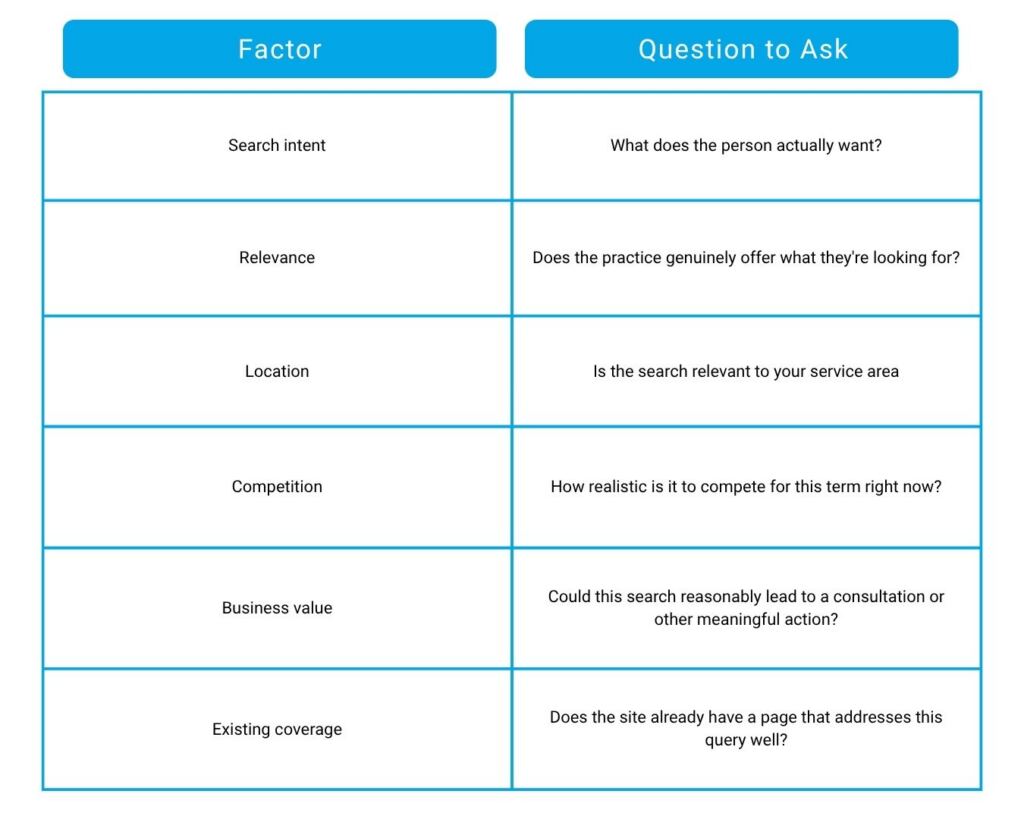
chart

The highest-volume keyword isn't automatically the best one. A focused term like “Sculptra in [city]” may bring fewer visitors than a broad term like “anti-aging,” but those visitors are far more likely to want exactly what you provide.

How to Match Keywords to the Right Page

Keyword research becomes most valuable when each search is paired with the page best suited to answer it.
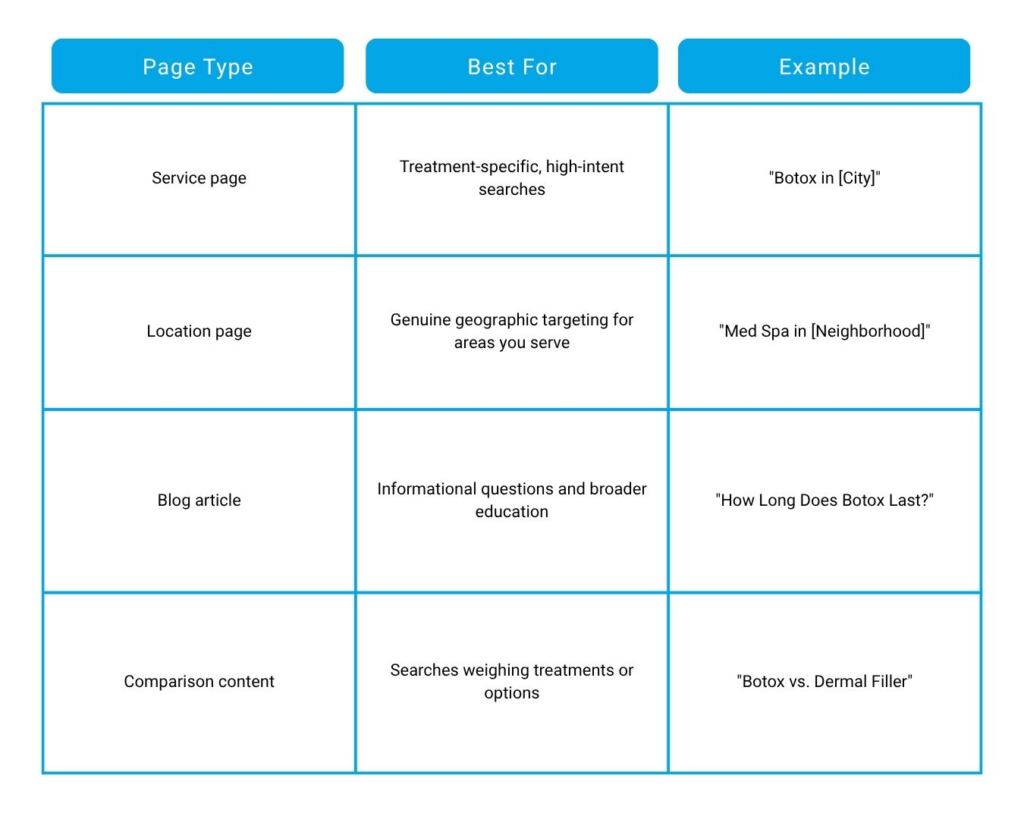
chart

Service Pages

Service pages are the natural home for searches from someone ready to explore a specific treatment. They should explain the treatment clearly and make booking easy.

Location Pages

Location pages work best when the practice truly serves that area. They should offer useful, location-relevant information rather than repeating the same content with a different city name.

Blog Articles

Educational articles answer the questions patients ask while researching, then link to the related service page when readers are ready for the next step.

Comparison Content

Comparison pieces help people understand their options side by side, which is often exactly what they need before scheduling a consultation.

Not every keyword needs its own page. Closely related terms like “lip filler cost” and “how much is lip filler” usually belong together. For the competitive side of treatment searches, see our guide to ranking for competitive treatment searches.

How Many Keywords Should a Med Spa Target Per Page?

A specific keyword count isn't the right goal. A single thorough page can naturally rank for dozens of related queries because search engines understand that “Botox,” “Botox injections,” and “Botox treatment” describe the same topic.

A more helpful framework is:

One primary topic + closely related search terms + clear search intent

When a page fully answers its topic, related searches tend to follow. The same thinking applies across your whole site, which we explore in our article on how many pages your med spa website needs.

Common Med Spa Keyword Research Mistakes

Targeting Search Volume Instead of Intent

A popular keyword only helps if it matches what the practice offers and what the searcher wants.

Creating a Separate Page for Every Keyword

Closely related searches are usually better served by one strong page than several thin ones.

Ignoring Local Intent

Since med spas serve a specific market, location signals matter for most commercial searches.

Using Keywords the Practice Doesn't Actually Serve

It's best to build content around treatments you genuinely provide, even when other terms have appealing volume.

Targeting the Same Keyword on Multiple Pages

Overlapping pages can make it unclear which one should rank. Giving each page a distinct purpose keeps things clear.

Forgetting Existing Rankings

Before creating something new, check Search Console. Your site may already earn impressions for related searches, and improving an existing page can be a quicker win.

Build a Keyword Strategy, Not Just a Keyword List

The most useful outcome of keyword research isn't a spreadsheet. It's a content map that shows:

  • Which services deserve dedicated pages
  • Which locations need legitimate local pages
  • Which questions deserve blog content
  • Which topics can be combined
  • Which pages should link to one another
  • Which opportunities to prioritize first

That map connects naturally to the rest of your SEO work, from your med spa SEO checklist to your Google Business Profile and your approach to AI search.

Keyword research isn't about finding more keywords. It's about understanding what your potential patients are searching for and deciding which page should answer each search. If you'd like support building that map for your practice, the Medstar Media team is always happy to help. Book your free strategy session today!

Frequently Asked Questions About Med Spa Keyword Research

What keywords should a med spa target?

A med spa should focus on keywords tied to the treatments it actually offers, the concerns those treatments address, and the local area it serves. Service and location terms like “lip filler in [city]” support service pages, while questions like “how long does filler last” support educational content. The best targets combine clear intent, real relevance to your practice, and reasonable business value, rather than simply the highest search volume.

How do I find keywords for my med spa?

Start by listing every service you offer and brainstorming variations around cost, results, recovery, candidacy, and location. Then gather questions from consultations, phone calls, and your front desk team, since these reflect how real patients talk. Finally, validate your list with Google Keyword Planner and Google Search Console to understand volume, competition, and which queries already bring visitors to your site.

How many keywords should a med spa target?

There isn't an ideal number. Most med spas benefit from focusing on core treatments and their local market first, then expanding into educational and comparison topics over time. At the page level, think in terms of one primary topic supported by closely related terms. A well-written page can rank for many variations naturally, so quality and depth matter more than hitting a keyword count.

Should every med spa service have its own keyword?

Most core services benefit from a dedicated page built around a primary topic, such as Botox or microneedling. That doesn't mean every variation needs its own page. Related terms like “Botox injections” and “Botox treatment” can live on one page. Smaller or closely related services may also fit well together on a shared page when patients tend to research them side by side.

Should med spas target “near me” keywords?

“Near me” searches reflect strong local intent, but they work differently than other keywords. Google interprets them using the searcher's location, so adding “near me” to page copy doesn't do much on its own. Local relevance comes from accurate location information on your site, a well-maintained Google Business Profile, consistent listings, and service pages that clearly reference the areas you serve.

How often should a med spa update its keyword strategy?

A quarterly review works well for most practices, with a deeper review once a year. It's also worth revisiting when you add a treatment, open a new location, or notice shifts in Search Console data. Search behavior keeps evolving, especially as GEO and SEO continue to converge, so regular check-ins keep your content aligned with what patients are looking for.


Picture of About the Author
About the Author

I’m Chris Zelig, Founder & CEO of Medstar Media. I’ve spent over 15 years in the aesthetics and cash-pay medical space, building my career on a lesson my dad taught me early on—keep things simple, fast, and easy. That mindset has become the cornerstone of my marketing approach. I focus on helping small, privately owned providers outperform larger competitors. My first aesthetics client, SKINNEY Medspa, grew from a family-run business into New York City’s #1 medical spa and the world’s leading provider of CoolSculpting and Emsculpt. Since then, I’ve gone on to represent top cosmetic accounts nationwide and create viral campaigns for causes such as early cancer detection.

STEP 1 OF 2 50%

SCHEDULE YOUR FREE MARKETING STRATEGY SESSION BELOW!

We will share with you the strategies the top 1% of providers use to acquire more patients. I will also give you a custom marketing strategy and audit your current website.

Vania

Behind the Screens

I make sure people call their new medspa friends back.
Consistent and creative follow-up with leads
My background in trauma-focused therapy.
A value-based monthly membership program with fun activations keeps your client base engaged with new services and following the recommended treatment protocols.
Christine A.

Behind the Screens

I make internet pictures that try to win people’s attention. Basically, I figure out what will make someone stop scrolling, look twice, and hopefully think, “Hmm, I want that.”
Canva. We’ve spent an unreasonable amount of time together. It’s quick, flexible, and lets me go from a random idea to something people can actually see and react to without making the process unnecessarily complicated.
I’m surprisingly good at making things look effortless, after several very non-effortless attempts. I enjoy taking messy ideas, lots of information, or vague feedback and turning them into something clear and easy to understand.
Don’t guess what works. Test it. Something can look brilliant in theory and completely flop in practice, so I’d rather let the audience tell us what works and keep improving from there.
Rafael A.

Behind the Screens

There are steps needed when handling leads to get the best results possible. It is my job to train practices in these steps and to make sure that, after the training, these steps are taken. I follow up with the teams to address areas of opportunity to constantly improve the lead management process.
My favorite marketing tool is the Medstar App, especially when it’s set up correctly for lead management, automations, follow-up, SMS/email campaigns, and pipeline visibility. It helps connect marketing efforts directly to conversion outcomes.
Besides a magnetic smile, I bring strong lead-management and process-optimization skills. I’m good at reviewing workflows, finding gaps, and helping teams turn more leads into booked appointments.
Don’t let good leads die because of slow follow-up. Marketing gets the lead in the door, but the process behind it is what actually closes the appointment.
Kylie N.

Behind the Screens

I help businesses show up when people search for things on Google. It’s kind of like helping a business put up the right signs so people can find their way to it, only you’re looking online instead of in person.
Google Search Console. I love digging through search data and finding little opportunities hiding in plain sight. It feels a bit like detective work.
Professionally, I’m surprisingly good at turning a big, messy pile of information into something organized and actionable. Personally, I’m a seasoned pro at collecting hobbies.
Don’t create content for algorithms; create it for people. Understand what your audience actually wants to know, then use SEO to help them find it.
Areesha T.

Behind the Screens

I help people work together to build cool things on the internet.
Paint the canvas, spending time with friends & family.
Understanding their vision and helping turn ideas into real results.
Know your audience first — great marketing starts with understanding people.
ChatGPT — my brainstorming partner for ideas and problem-solving.
Nathalia G.

Behind the Screens

I usually step away from the project and do something creative, such as painting, drawing, or listening to music. Giving my mind a break often helps the missing puzzle piece fall into place. When I need inspiration, I like exploring other creative outlets and using them to approach the project from a new perspective.
Spending time with my family and friends! I really value the people around me and enjoy slowing down, being present, and staying offline during those moments.
Always consider the customer and their needs before creating a strategy or plan. One should guide the other. When you understand your audience and maintain strong communication with the client, digital marketing projects tend to run more smoothly and successfully.
Honestly, I’d say Instagram. I love using it to spot trends, see what people are responding to, and understand how brands are connecting with their audiences. A lot of my best ideas come from observing what feels natural on the platform and then finding a way to make it work for the brand.
Positivity! I’m usually the one cheering people on, celebrating the little wins, and bringing good energy to the conversation.
Carie G.

Behind the Screens

I love putting on some music, it always helps me get into the right headspace and set the tone for my design work. Matching the vibe of the music to the brand’s aesthetic is my favorite way to find fresh creative motivation.
When I’m off the clock, I love walking the nature trails near my home or relaxing with a good book. Anything that gets me away from screens to recharge.
Always ask yourself if the content you’re creating will truly resonate with your audience. It needs to feel personal and authentic, rather than just pushing out content for the sake of it.

Definitely Adobe After Effects. It’s my absolute go-to for editing video content, especially for social media. With so many options for detailed motion graphics, I really couldn’t live without it.

I love using my design skills to bring a client’s vision to life. Seeing them excited about the final result is the best feeling, and I thrive on collaborating hand-in-hand to build their brand.
Bryan G.

Behind the Screens

I like going to the movie theater, reading, or hanging out with my family.
Claude
Response time
I like to go for a walk in nature, especially by the water.
I make sure the people who hire our company are happy.

Bre C.

Behind the Screens

When I’m off the clock, I love spending quality time with my two kids—whether we’re playing or just hanging out, I try to be as present as possible with them. It’s the best way for me to recharge and stay grounded.

My favorite digital marketing tool is Canva because it makes designing quick, easy, and fun, especially with the wide variety of templates available. It’s great for creating polished content efficiently.

One piece of advice I always follow is to keep learning—digital marketing is constantly evolving, so staying curious and adaptable really makes a difference. It helps you stay ahead and bring fresh ideas to the table.

When I feel stuck, I like to step away and go for a walk to get some fresh air; it helps me reset and come back with a clearer, more creative mindset. Even a short break can make a big difference.

I also bring a graphic design background to the team, which helps me review mockups with a trained eye and offer thoughtful, practical feedback to clients. It allows me to bridge both strategy and visual execution effectively.

Myranda G.

Behind the Screens

During the week, I’m certainly a home-body! I’m within walking distance to pilates, so I do love to take advantage of that as well as get outside and go for a walk on the lake. Outside of that, I love to try new recipes, spend time with my dog and binge the best reality TV. On the weekend, I’m an avid errand runner, so you’ll find me out and about getting coffee, running to Target at least 3 times, and taking part in some sort of self-care routine!  
Most people build their career around a title – I built mine around an industry I have a genuine passion for. Over the past 10 years in aesthetics, I’ve worked across operations, practice management, sales, marketing, customer success, and coaching. Because of that, I’m able to do more than just fulfill a role! I understand the moving parts, pressures, and responsibilities that go into helping an aesthetic practice truly thrive. 
My goal in everything I do is to make a positive impact in the people’s lives I’m introduced to, whether that’s for the short term or the long term. There’s very few places people can go to with an insecurity or something they want to fix – or my preferred way of seeing it, enhance. This industry allows you to be a part of that. You meet people from all different walks of life, get to know them on a personal level and be a part of sometimes the best and worst stories of their lives in real time. We get to shape that experience in a positive way. And working with our clients where we focus on bringing these new patients to them, allows me to be a part of a positive experience that touches so many more people. I’m a big believer that whenyou keep the people you work with happy, that translates down to the client themselves, their team and then to their patients. That brings me so much fulfillment – a single experience can change everything. 
You have to take your personal bias out of what you think works. Sometimes what you think may be the best ad you’ve ever launched, produces the lowest results. Marketing is a strategy and where quality is always a top priority, success is number one! An algorithm can be unpredictable, so trust what the data and analytics are showing you and let’s use them to accurately monitor the outcomes!
I love to step away for a moment and purge. When I’m feeling stuck or at a standstill, it’s time to make room for new ideas and to get my brain flowing in a whole new way. Sometimes that’s a small project like finding a junk drawer and decluttering. Other times it’s my closet or my garage! But when I am able to spend time getting rid of things, I get super inspired by a newly organized space and start thinking of all the new things I could do to continue improving – it then spirals to all aspects and I feel completely re-energized and re-focused!
Jackie M.

Behind the Screens

Imagine your school principal has SO many things to do that they can’t keep track of everything by themselves. The Chief of Staff is the person who helps organize things, reminds people what to do, solves problems, and makes sure everyone works together nicely, like the person who keeps the whole team running smoothly.
When I’m off the clock, I’m usually with my husband and our two boys — swimming, traveling, spending time at the beach, and being talked into roller coasters at Universal Studios that I immediately regret. I’m also a big musical theater fan, love singing whenever I get the chance, and am always looking for new restaurants and recipes to try. And once the kids are asleep, you can usually find me unwinding with a true crime documentary or a little too much Bravo reality TV.
My guilty pleasure in the digital world is definitely TikTok — I’ll tell myself I’m just going to “check one thing,” and suddenly I’ve fallen into an hour of everything from recipes to random deep dives I didn’t know I needed.
I’m surprisingly calm. No matter how hectic things get or how many moving parts are in play, I tend to stay steady, think clearly, and help keep things grounded so the team can focus and move forward without the panic spiral.
I usually spark creativity by stepping away from whatever I’m stuck on and getting outside for a walk. Fresh air and movement help reset my thinking, and I’ll usually put on music to shift my mood and break out of the loop I’m in. That combination helps me come back with a clearer head and new ideas.