
You invested in a professional website. Your treatment pages are live, the photos look polished, and you may have published a few blog posts. Yet when you check your analytics, Google sends only a trickle of visitors, and very few of them book consultations.
If you’ve been wondering why your med spa website is not getting traffic, you’re far from alone. A website can look beautiful and still struggle to appear in search results, because organic traffic depends on much more than design. Technical accessibility, keyword targeting, search intent, local visibility, content quality, and competition all play a part.
The most helpful first step is figuring out where the gap actually is. Publishing more content or redesigning the site can feel productive, but neither will solve a problem it doesn’t address.
Below are nine common reasons med spa websites struggle to earn organic traffic, how to check each one, and how to decide what to fix first.
1. Google Isn’t Indexing Your Website or Important Pages
Before a page can bring in organic visitors, it has to move through four stages:
- Crawling: Google discovers and reads the page.
- Indexing: Google stores the page so it’s eligible to appear in results.
- Ranking: Google decides where the page appears for a given search.
- Clicks: Searchers choose your result and visit the site.
Being indexed makes a page eligible to appear in search results, but it doesn't guarantee strong rankings or clicks. If a page never makes it into the index, it can’t rank at all. Common causes include:
- An accidental
noindextag left on after development - Robots.txt rules that block Google from crawling key sections
- A missing or misconfigured XML sitemap
- Broken pages, server errors, or redirect chains
- Indexing problems introduced during a redesign or migration
- New treatment pages that Google simply hasn’t discovered yet
How to Check
Google Search Console’s Page Indexing report shows which pages are indexed and why others are excluded. The URL Inspection tool lets you check an individual page and request indexing once an issue is fixed. A site:yourdomain.com search can give a quick first impression, but it isn’t a complete audit.
Actionable takeaway: Confirm that your homepage, core service pages, and key landing pages are indexed before investing in new content.
2. Your Website Isn’t Targeting the Right Keywords
Mentioning a treatment on your site doesn’t mean it will rank for the searches patients actually use. Targeting often falls short when a site:
- Aims at broad, highly competitive terms without a realistic plan
- Uses internal service names instead of the words patients search
- Leaves out location-specific language
- Builds content around topics unrelated to the practice’s services
- Tries to serve several unrelated search intents on one page
- Overlooks specific treatment and concern-based searches
Consider the difference between “skin rejuvenation” and “RF microneedling in [City]” or “laser treatment for acne scars in [City].” The broad phrase is vague and crowded. The specific searches come from people who know what they want and where they want it.
Strong keyword targets balance relevance, search intent, competition, location, and business value, with search volume serving as just one consideration. A structured approach to med spa keyword research can help you identify valuable search opportunities and build a more effective page plan.
Actionable takeaway: Make sure each core treatment page targets a specific, relevant search tied to your market.
3. Your Service Pages Are Too Thin or Generic
Treatment pages carry much of a med spa’s organic visibility. A single “Services” page listing Botox, dermal fillers, lasers, and body contouring in a few lines can’t answer the distinct questions patients have about each one.
A useful service page usually covers:
- What the treatment is and its purpose
- The concerns or goals it may address
- Candidacy considerations and consultation expectations
- What patients can generally expect during treatment and recovery
- Frequently asked questions
- Provider qualifications and clinical oversight
- Location details and a clear consultation call to action
Every page should offer accurate, meaningful information rather than repeat keywords, and it should avoid unsupported claims about results. If you’re unsure whether your treatment menu calls for more dedicated pages, it helps to consider how many pages a med spa website should have based on the services you truly offer.
Actionable takeaway: Give each priority treatment its own in-depth page instead of grouping everything on one list.
4. Several Pages Are Competing for the Same Search
Sometimes a site has plenty of content, but multiple pages target the same topic. A Botox service page, a “Botox specials” page, and three blog posts all aimed at “Botox in [City]” can leave Google unsure which page to show. As a result, none of them may rank as well as a focused page would.
How to Spot Overlapping Pages
In Search Console, filter the Performance report by a query and look at the Pages tab. If several URLs share impressions for the same search, they may be overlapping.
Actionable takeaway: Give each page one clear purpose, and consolidate or differentiate pages that overlap.
5. Your Local SEO Signals Need Strengthening
Many med spa searches carry strong local intent. Prospective patients want a qualified provider somewhere convenient, so your geographic relevance matters. Common gaps include:
- The website doesn’t clearly name the city or service area
- Location and treatment pages lack useful local context
- Business name, address, and phone details are inconsistent across the web
- The Google Business Profile is incomplete or rarely updated
- Reviews are limited or go unanswered
- The site shares little about the providers or the physical location
Local organic results and Google Maps results are related, but they aren’t the same thing. Strengthening your Google Business Profile can boost Maps visibility, but it won’t fix website issues like thin pages or indexing errors.
Actionable takeaway: Review local visibility separately from traditional organic rankings, and make sure your website and Google Business Profile accurately represent the practice.
6. Your Website Has Technical SEO or User Experience Problems
Technical issues can make a site harder for search engines to understand and harder for patients to use. Areas worth reviewing include:
- Slow-loading pages, especially on mobile
- Poor mobile usability
- Broken internal links and confusing navigation
- Duplicate or competing URLs
- Missing or unclear page titles and headings
- Disorganized site architecture
- Important pages that are hard to reach from the main menu
- Redesigns that removed content or changed URLs without redirects
Not every imperfection hurts rankings. A single speed score rarely explains a traffic problem on its own. Focus first on issues that affect crawling, indexing, usability, or Google’s understanding of your content, using Search Console, mobile performance testing, and a walk-through of key patient journeys.
Traffic and conversions are separate measures, but usability shapes what happens after someone arrives. Many of the same friction points show up among the website mistakes that kill med spa consultation requests.
Actionable takeaway: Prioritize technical fixes by their effect on crawling, indexing, and usability rather than chasing every warning.
7. Your Content Isn’t Building Topical Authority Yet
A few short, generic blog posts may not show the depth of information on your website, especially when competing practices publish comprehensive educational resources. A cohesive body of helpful, relevant content can help search engines understand your services, the topics you cover, and how your educational resources relate to your treatment pages.
An integrated content strategy usually involves:
- Educational content that supports each priority treatment
- Articles on concerns, candidacy, recovery, comparisons, and common questions
- Visible provider expertise, with clinical information reviewed for accuracy
- Regular updates to existing pages when information changes or performance slips
- Internal links connecting related articles and service pages
- A focus on usefulness over volume
Publishing more isn’t automatically the answer. In a healthcare-adjacent field, visitors are making real decisions about treatments and providers, so people-first content that answers their questions clearly carries more weight than repetitive posts.
This approach is central to ranking for competitive treatments like Botox and fillers, and it also supports visibility as AI tools reshape search, a shift explored in GEO vs. SEO for med spas.
Actionable takeaway: Build supporting content around your highest-value treatments before expanding into broader topics.
8. Your Website Lacks Strong Internal Links and External Authority
Search engines use links to discover pages and understand how content relates. Common missed opportunities include:
- Blog posts that never link to relevant treatment pages
- Key service pages buried deep in the site
- Generic anchor text like “click here” instead of descriptive wording
- Broken internal links
- Few high-quality external links pointing to the site
For example, an educational article about acne scarring could link naturally to a laser resurfacing page, as long as the practice offers that treatment and the page genuinely helps the reader.
External backlinks can support authority, but relevance and quality matter far more than quantity. Genuine mentions from local organizations, professional associations, and industry publications are worth pursuing. Avoid purchased links and manipulative schemes, since they can do more harm than good.
Actionable takeaway: Link every educational article to the most relevant service page, and look for real local partnerships that earn natural mentions.
9. You’re Expecting Results Too Quickly or Measuring the Wrong Things
Organic growth takes time and depends on your starting point, competition, technical condition, content quality, and consistency. The typical timeline for a med spa to rank on Google reflects how gradual that process can be. Compare equivalent date ranges and account for seasonal changes in treatment demand, promotions, and local search behavior before concluding that your organic performance has declined.
Each metric tells a different part of the story:
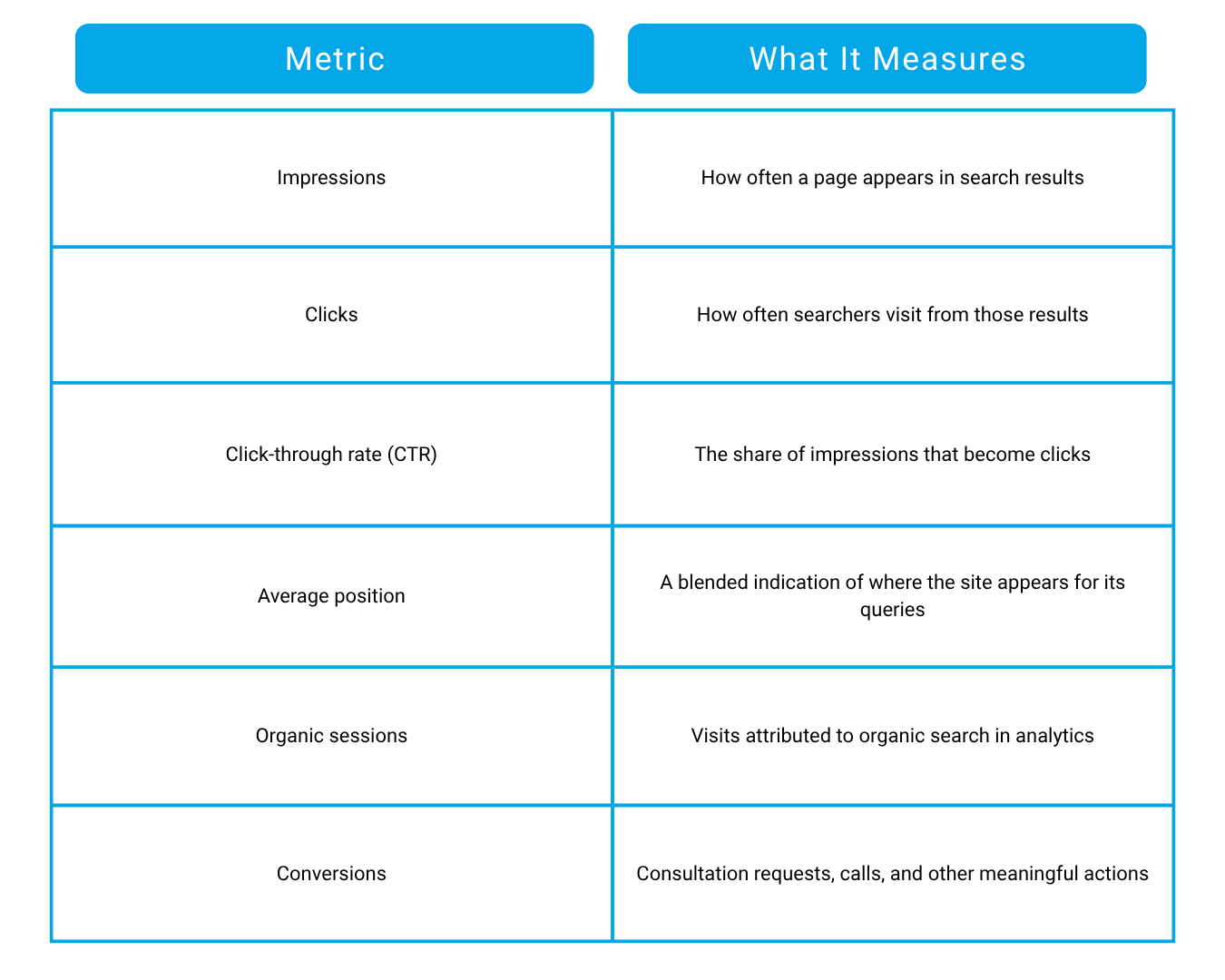
What the Numbers Can Reveal
- Low impressions may point to indexing issues, limited visibility, or weak keyword targeting.
- Impressions without clicks may indicate that your titles and descriptions need improvement, but ranking position, search intent, and features such as AI Overviews can also influence whether users click your result.
- Traffic without inquiries usually signals a separate conversion problem.
AI Overviews and other search features can change how people interact with results, so fewer clicks doesn’t always mean lost visibility. Reviewing Google Search Console and GA4 together shows both search performance and on-site behavior, and benchmarking against how many leads a med spa should generate each month keeps traffic tied to business goals.
Actionable takeaway: Track impressions, clicks, and conversions side by side before deciding what’s actually underperforming.
How to Diagnose Your Med Spa’s Organic Traffic Problem
Work through these steps in order:
- Check indexing. Confirm the homepage and priority service pages are accessible and eligible for indexing.
- Review Search Console. Compare clicks, impressions, CTR, and average position over a meaningful period.
- Identify underperforming pages and queries. Note which services and searches are missing.
- Audit keyword targeting. Confirm each important page matches a relevant intent and market.
- Evaluate service pages. Check for thorough, accurate information and clear paths to related services.
- Review local visibility. Examine location relevance and Google Business Profile performance.
- Inspect technical health and internal links. Prioritize critical errors, broken links, and hard-to-find pages.
- Create an improvement plan. Address high-impact technical issues first, then content, on-page optimization, and ongoing measurement.
A sudden drop in established traffic calls for a different approach than a new site with little visibility. For a decline, compare performance before and after the change and investigate likely causes, such as a migration or URL changes, before making sweeping edits. A med spa SEO checklist can help you stay organized.
Turn Your Med Spa Website Into a Source of Organic Growth
Low organic traffic rarely comes down to one universal cause. It might involve indexing, keyword targeting, local SEO, service page depth, technical performance, content strategy, competition, or simply a timeline that needs more patience.
The encouraging part is that each of these is identifiable and fixable. Diagnosing the issue before committing to a redesign or a stack of new blog posts saves time and keeps your investment focused on what will actually move your visibility forward. A focused SEO audit can show which issues are limiting your site and which improvements deserve attention first.
Ready to find out what’s holding your med spa website back? Book a free strategy session with Medstar Media online, or call us at (801) 890-3847 to talk through your organic search performance and where your biggest opportunities are.
Frequently Asked Questions
Why is my med spa website not showing up on Google?
The most common reasons include indexing issues, such as a noindex tag, a robots.txt block, or a missing sitemap, as well as pages that don’t target specific searches. Checking the Page Indexing report in Google Search Console is the fastest way to confirm whether your key pages are eligible to appear in results.
How do I check if my website is indexed by Google?
Google Search Console is the most reliable place to look. Its indexing reports list the pages Google has stored, along with why it left some out, and you can look up individual URLs to see their status. Once you fix an issue, you can ask Google to recrawl the page so the update is picked up sooner.
Why is my med spa website not ranking for treatments?
Treatment pages often struggle when they’re thin, combined with other services, missing location details, or competing with other pages on the same site. Giving each core treatment a dedicated, thorough page that answers patient questions and clearly references your area gives Google stronger reasons to rank it.
How can I get more organic traffic to my med spa website?
Start by confirming your important pages are indexed. From there, build in-depth service pages around specific treatment and location searches, publish educational content that answers real patient questions, keep your Google Business Profile current, and link related pages together. Consistency over several months matters more than any single change.
Will a website redesign fix my organic traffic?
Not necessarily. A redesign can improve speed and usability, but it won’t fix keyword-targeting gaps or thin content on its own. Redesigns can also introduce indexing problems if redirects and page structure aren’t handled carefully, so it’s best to diagnose the cause before rebuilding.
How long does it take to see more organic traffic after fixing SEO issues?
Technical fixes like removing a noindex tag can show results relatively quickly once Google recrawls the page. Content, local, and authority improvements usually take several months to build momentum. Watching impressions and keyword movement in Search Console helps you see progress before traffic rises noticeably.